 English
 中文简体
中文简体 عربى
عربىNews
Home / News / Industry News / Static vs Adhesive Window Film: Differences, Pros, Cons & How to Choose
Professional manufacturer of architectural decorative film, Decorative Film Supplier in China

Two rolls of window film sit side by side on a shelf. They look almost identical. One will peel off your glass in two years and leave nothing behind. The other will still be performing a decade later—but if you ever need to remove it, you'll be scraping adhesive residue for an hour. Choosing between them isn't complicated once you understand what each type is actually designed to do, and which of those designs matches your situation.
Content
Despite sharing a product category, static cling and adhesive window films stick to glass through fundamentally different mechanisms—and that difference determines almost everything else about their performance.
Static cling film (also called static film or non-adhesive film) adheres to smooth glass surfaces through molecular attraction: the same suction-cup effect that lets a wet piece of plastic cling to a window. The film contains no adhesive compounds. It adheres purely through close contact between two flat surfaces, and the bond strength depends entirely on how clean and smooth the glass is. Importantly, it is a common misconception that these films use static electricity. They don't—the name is a holdover from early marketing language. The mechanism is physical surface adhesion, not electrostatic force.
Adhesive window film uses a pressure-sensitive acrylic or silicone adhesive layer coated on the film's backing. When applied to glass, this adhesive forms a chemical bond that deepens and strengthens over time. The bond is permanent in normal use—designed to hold for years under temperature cycling, UV exposure, and humidity without lifting, bubbling, or peeling. Removal requires deliberate effort and typically leaves some adhesive residue on the glass surface.
This distinction—physical surface contact versus chemical bonding—is the root cause of every meaningful difference in performance, durability, and use case between the two types.
Durability is where the gap between static and adhesive film is most pronounced, and where the wrong choice creates the most frustration.
Static cling film typically performs well for one to three years under normal indoor conditions. The cling mechanism gradually degrades with exposure to heat, humidity, dust accumulation between film and glass, and the inevitable micro-contamination of the glass surface over time. In hot climates or south-facing windows with sustained direct sun, this degradation accelerates. High-humidity environments—bathrooms, kitchens, pool areas—are particularly challenging for static film because moisture disrupts the close surface contact that creates the cling. Edges begin lifting first, followed by bubbling across the surface. Once the cling degrades, the film cannot reliably be re-adhered to the same surface.
Adhesive window film is a fundamentally different proposition for longevity. Professional-grade adhesive films are rated for ten to twenty years of exterior or interior service when properly installed. The adhesive bond is unaffected by humidity, and quality films are formulated with UV stabilizers that prevent the adhesive layer from yellowing or losing bond strength over the film's rated service life. For building applications where thermal performance, UV rejection, or security is the objective, adhesive film's durability makes it the only viable long-term solution. Research published in peer-reviewed building science literature confirms that high-efficiency adhesive window films can reduce Solar Heat Gain by 50–75% over their service life, with performance metrics including Solar Heat Gain Coefficient (SHGC) and Total Solar Energy Rejected (TSER) used to quantify their sustained thermal contribution to building energy efficiency.
Static cling film is considerably more forgiving to install than adhesive film, and this is one of its genuine practical advantages.
Because there is no adhesive, positioning errors during installation are inconsequential. The film can be lifted, repositioned, and reapplied repeatedly until correctly placed. Air bubbles and misalignments are corrected simply by peeling back and reapplying. No squeegee technique or chemical solution is required, though spraying the glass surface with water before application helps the film position smoothly. The entire installation process is accessible to anyone without prior experience, and mistakes are reversible with no consequences for the film or the glass.
Adhesive film installation is more demanding. The glass must be scrupulously clean—any dust, oil, or debris trapped under the adhesive creates a permanent bubble or blemish. The film is typically applied wet (using a soapy water solution) to allow positioning before the adhesive bonds, but this window for repositioning is time-limited. Once the film begins to dry, it commits to its position. The backing must be removed carefully to prevent the adhesive surface from touching itself, as re-separation can damage the adhesive layer. Large panels require a second person and methodical technique to avoid wrinkles. Professional installation is recommended for anything above a small panel, both to ensure adhesion quality and because mistakes with adhesive film mean replacement, not repositioning.
For glue-free static glass films using adsorption close-fit technology, installation is particularly straightforward: clean the glass, wet the surface lightly, apply the film, and smooth out any bubbles with a squeegee. No special tools, no adhesive chemicals, and no irreversible commitment to a position.
Removal behavior is one of the most practically important differences between the two film types, and often the deciding factor for renters, temporary installations, and anyone who anticipates changing the film.
Static cling film removes instantly and cleanly. Peel from a corner, pull slowly, and the glass is left exactly as it was—no residue, no marks, no cleaning required. The film itself can typically be stored and reused multiple times before its cling properties degrade enough to prevent re-application. This reusability makes static film genuinely cost-effective for seasonal applications, rental properties, display windows, and temporary privacy needs.
Adhesive film removal is a more involved process. The film must be lifted and peeled—ideally in one piece to minimize residue—and the adhesive layer left on the glass must then be removed with a solvent (typically isopropyl alcohol or a commercial adhesive remover) and a razor blade or scraper. The process is manageable, but it takes time and care to avoid scratching the glass. On older glass or coated glass surfaces, aggressive removal can cause damage. This is why adhesive film is generally described as semi-permanent: it will stay until you want it gone, but "gone" requires deliberate effort rather than a simple peel.
Both film types are available in a wide range of visual effects—frosted, patterned, tinted, mirrored, and decorative—and both can provide meaningful privacy. The performance differences emerge when the application demands more than aesthetics.
Privacy: Both static and adhesive films deliver effective privacy in frosted or patterned designs. For decorative applications where the primary goal is visual effect and the installation is temporary or subject to change, static film performs the same function as adhesive film with lower installation commitment. For glass adhesive films with rich aesthetic patterns intended as permanent interior design elements, adhesive construction ensures the visual effect remains crisp and edge-stable for years without the lifting or peeling that affects static film over time.
Heat rejection and solar control: This is where adhesive film has a clear functional advantage. High-performance solar control films use metallic or ceramic coatings to reflect and absorb infrared energy, reducing solar heat gain through glass. These coatings require a stable, firmly bonded substrate—the chemical bond of an adhesive film provides this stability. Static film can incorporate basic tinting but cannot reliably support the coating technologies that drive meaningful thermal performance. For applications where energy efficiency is a measurable objective, strong thermal insulation building heat-resistant adhesive films deliver documented solar heat rejection, reducing cooling load and improving interior comfort in ways that static film simply cannot replicate.
UV blocking: Quality adhesive window films block up to 99% of UV radiation in the 300–380 nm range. UV protection is a function of the film's base material and any UV-absorbing additives in the film or adhesive layer. Static film can incorporate UV-absorbing compounds, but its shorter service life means UV protection degrades with the film—often when the window's sun exposure is highest. For protecting furnishings, flooring, and artwork from UV-induced fading, the longevity of adhesive film makes it the more reliable choice over any extended period.
Static cling film requires a smooth, non-porous surface. On textured glass, frosted glass, uneven surfaces, or any glass that isn't optically smooth, the physical contact that creates cling cannot form uniformly—the film won't adhere, or will adhere poorly with visible gaps and early edge lifting. This limits static film to standard flat glass in good condition.
Adhesive film's chemical bond is less surface-sensitive. It adheres to textured glass, lightly frosted surfaces, and glass in less-than-perfect condition—though very heavily textured surfaces still challenge adhesion. Adhesive films are also available for exterior glass application, where static film would have no ability to hold against wind, rain, and outdoor environmental stress. For commercial and architectural applications where the glass substrate may vary, adhesive construction is more reliable across a wider range of conditions.
Both types require a clean surface for optimal performance. On static film, contamination prevents the cling mechanism from forming. On adhesive film, contamination creates trapped debris under the adhesive layer that appears as permanent blemishes. The standard preparation—clean with isopropyl alcohol or glass cleaner, then rinse with clean water—applies to both film types before installation.
Adhesive window film is generally less expensive than static cling film at equivalent size and specification. The cost difference reflects the simpler manufacturing process for adhesive-backed film—applying a pressure-sensitive adhesive to a polyester base is a more commodity process than engineering a film that achieves effective cling without adhesive.
Over a longer time horizon, however, static film's reusability partially offsets its higher unit cost. If a static film is removed, stored properly, and reapplied multiple times over several years, the cost per installation cycle is lower than purchasing a new adhesive film for each installation.
For large-area applications—commercial buildings, offices, large residential windows—the cost differential between film types becomes secondary to performance and service life. The labor cost of installation and any future removal typically exceeds the film cost itself, making durability the dominant economic consideration. An adhesive film that lasts fifteen years costs less per year of service than a static film replaced every two years, regardless of unit price. Glass decorative films in both static and adhesive constructions are available across a range of specifications, allowing a direct comparison of materials at equivalent aesthetic and functional specifications before committing to a film type.
The decision framework is straightforward once the key variables are identified:
The two types are not competitors for the same use case—they are solutions to different problems. Static film excels at reversibility, ease, and flexibility; adhesive film excels at durability, performance, and versatility across surface types. Identifying which of those properties the application actually needs is the only decision that matters.
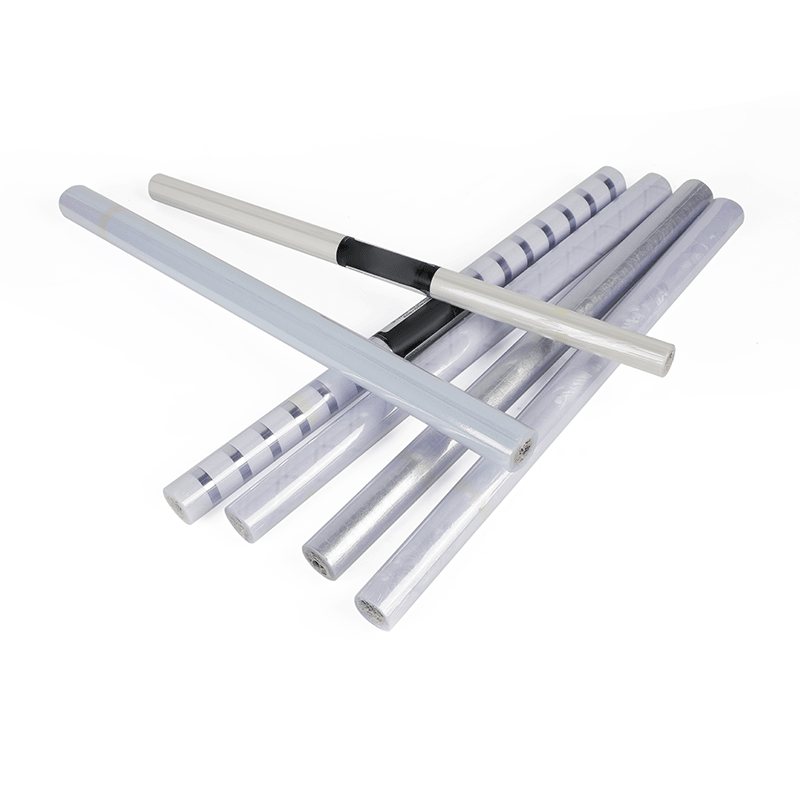

To increase our production capacity, Han Yang has invested in a range of advanced equipment, including gravure printing machines, lamination machines, coating machines, and embossing machines. Architectural Decorative Film Supplier and Decorative Film Factory in China.

 Previous