 English
 中文简体
中文简体 عربى
عربى
News
Content
How Long Does Self-Adhesive Vinyl Last?
Some installs are still holding strong fifteen years later. Others start peeling at the corners before the first month is even out.
Same product, wildly different outcomes. The real difference almost always comes down to two things: what grade of vinyl you bought, and where you stuck it.
Quick answer: Permanent self-adhesive vinyl typically holds for 3 to 5 years outdoors, and 5 to 7 years indoors.
Removable vinyl is a different animal — good for 1 to 2 years indoors, and not really built for outdoor use at all.
But those numbers come with a catch. They assume the surface was actually cleaned and prepped, and that the film wasn't left baking in direct sun or sitting under standing water.
Skip either step, and even a well-made roll of vinyl can fail in a matter of weeks.
| Vinyl Type | Indoor Lifespan | Outdoor Lifespan |
|---|---|---|
| Permanent (cast film) | 5–7 years | 5–10 years |
| Permanent (calendered film) | 4–6 years | 3–6 years |
| Removable / low-tack | 1–2 years | Weeks to a few months |
Cast film tends to win out here for a simple manufacturing reason — it's poured rather than stretched, so there's less internal stress baked into the material and less shrinkage down the road.
Calendered film is the budget option. Nothing wrong with it for a short-term job. But once heat and UV start working on it, it shrinks and cracks sooner than cast film does.
What Determines How Long Self-Adhesive Vinyl Lasts
Two rolls of vinyl can look basically identical sitting on a shelf. Applied to a wall, they might behave nothing alike.
Four things usually explain why: the adhesive itself, the surface it's going on, how carefully it was applied, and what it has to put up with afterward.
Adhesive formulation
This is the one people underrate. Acrylic pressure-sensitive adhesives simply age better than rubber-based ones — better UV resistance, less breakdown over time. That's why acrylic is the default choice for anything meant to last years rather than months.
There's an actual industry test for this. Manufacturers commonly rely on the industry-standard peel adhesion test for pressure-sensitive tape — it pulls the film off a panel at a fixed angle and speed, and measures exactly how much force that takes.
Get the peel strength dialed in correctly, and the film stays put for years without ripping paint off the wall when it finally does come down.
Surface compatibility
This is where most DIY installs go wrong. Vinyl wants a hard, smooth, non-porous surface to bond to.
Textured walls. Raw, unsealed wood. Even a faint film of kitchen grease you can barely see. Any of these can shorten the bond life — sometimes dramatically.
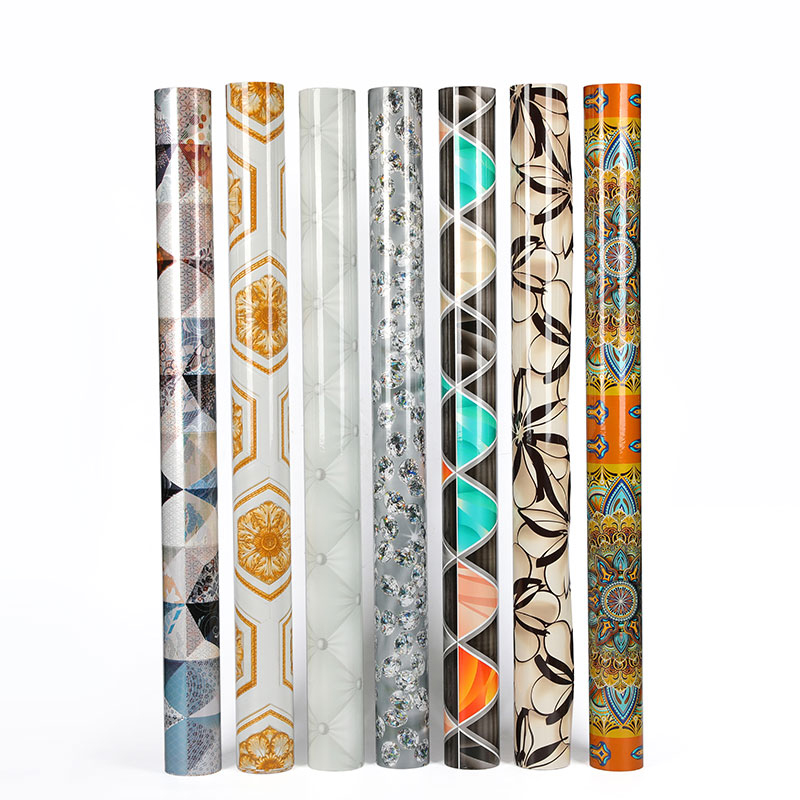
For wall and furniture projects specifically, durable self-adhesive foil options for walls and furniture already come with adhesive systems matched to painted drywall, laminate board, and metal panels — so a lot of that compatibility guesswork gets handled before the roll ever ships out.
Initial tack
Getting this wrong causes headaches either direction. Too aggressive, and it pulls paint off the wall on removal. Too weak, and edges start lifting within a few months.
There's a closer look at that trade-off in how PVC decorative film balances adhesion strength with long-term durability, which digs into why so much engineering time goes into fine-tuning this one property.
Indoor vs Outdoor Lifespan: What Changes
Indoor vinyl basically has it easy. No rain, no direct UV load, no daily swing between a hot afternoon and a cold night.
That alone explains most of the gap between indoor and outdoor lifespans for the exact same material.
Outdoors, three things do almost all the damage:
- UV light — breaks down the plasticizers in PVC film, which is what causes fading, brittleness, and eventually cracking.
- Moisture — water that creeps under an edge softens the adhesive and starts a lifting point that only gets worse with each temperature swing.
- Thermal cycling — repeated expansion and contraction stresses both the film and the bond underneath it.
Manufacturers actually test for the UV part directly, using standardized UV weathering testing for nonmetallic materials. It compresses months of real sun exposure into a lab cycle, which is how they predict outdoor performance before a product ever ships.
This is also why removable vinyl isn't rated for outdoor use at all — it uses a deliberately low-tack adhesive, and it just wasn't designed to resist water getting underneath it.
If what you actually want is a temporary look you can swap out without leaving residue, a glue-free removable static film for windows and glass sidesteps the whole adhesive-degradation problem. No adhesive at all — it clings through static instead.
For anything that has to survive outside long-term — signage, vehicle graphics, safety markings — the film needs UV inhibitors built into the formulation from day one. A weather-resistant reflective film built for outdoor signage shows what that looks like in practice: fully waterproofed, with an adhesive layer designed to keep holding through repeated wet-dry cycles.
How to Extend the Life of Self-Adhesive Vinyl
Most early failures trace back to the same handful of mistakes — and every one of them is avoidable.
- Clean the surface with soap and water first, then wipe it down with isopropyl alcohol and let it dry completely. Dust, grease, or fingerprints under the film weaken the bond right from the start.
- Use a squeegee, working from the center outward. Trapped air becomes a lifting point later on, even if it's invisible on install day.
- Match the transfer tape's tack level to the vinyl. Tape that's too aggressive can drag the design up during removal instead of releasing cleanly.
- Give the adhesive time to cure before putting the surface to heavy use. Bond strength keeps building for several days after application — washing or handling it too soon undoes some of that work.
- Keep it out of direct sun and standing water wherever that's practical, especially near windows or in bathrooms.
For surfaces that see a lot of contact or moisture — kitchen backsplashes, cabinet fronts, bathroom accents — it's worth starting with something built for that from the outset. An easy-to-clean heat-insulating film for wall panels has a surface coating designed specifically to shrug off the wipe-downs that would slowly dull a standard finish.
Shelf Life of Unused Vinyl in Storage
Here's something people don't expect: vinyl starts aging the moment it's manufactured, whether it ever gets applied or not.
An unopened roll typically holds its adhesive properties for somewhere between 6 months and 2 years — and how it's stored makes a real difference within that range. The usual recommendation is 15–35°C, with relative humidity somewhere between 20% and 65%.
A few small habits go a long way:
- Store rolls standing upright, not lying flat. Flat storage creates uneven pressure on the adhesive and can leave permanent flat spots.
- Keep rolls out of direct sunlight and away from anything hotter than roughly 24°C — heat speeds up the same plasticizer breakdown that shortens outdoor lifespan.
- If a roll has been sitting around for a year or more, test a scrap piece before committing it to a real project.
What does a failed test look like? The liner tears instead of peeling cleanly. The adhesive feels unusually soft or gummy to the touch. Either sign means the roll has likely aged past its useful window, even if it looks fine at a glance.
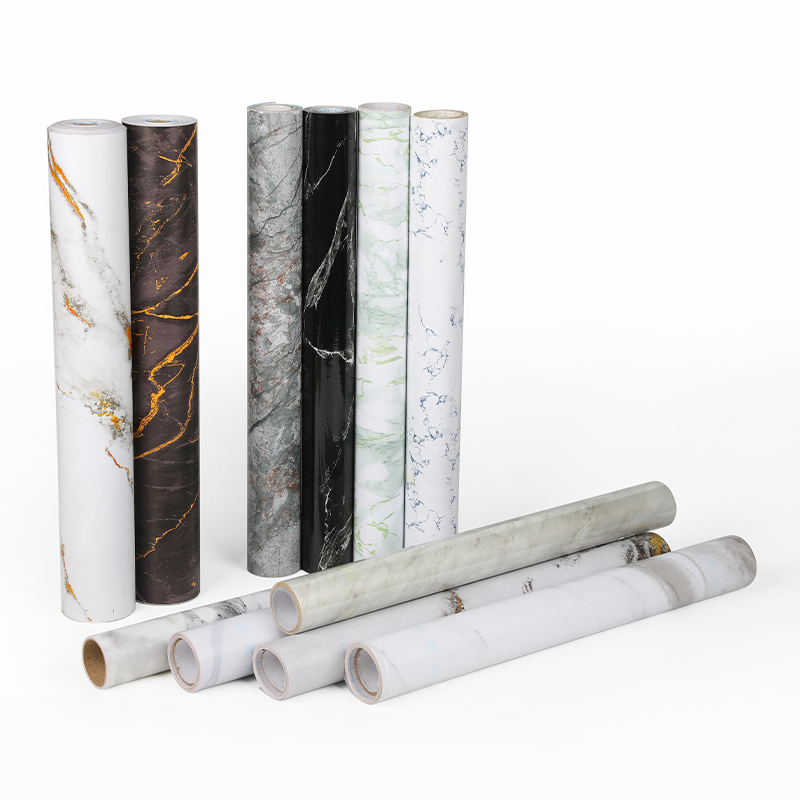
For projects where surface durability matters just as much as shelf stability — countertops, high-traffic furniture, marble-look panels — a chemical and corrosion-resistant marble-finish adhesive foil tends to hold up better both on the shelf and after installation than standard economy-grade film.
 Previous